Consider the following variation of the LinkedTree class’ insert()
method, which is supposed to associate a new data item with the specified
integer key key:
Determine what is wrong with this variation of the insert method
and then examine the correct insert method in the
LinkedTree.java file.
Binary tree traversals
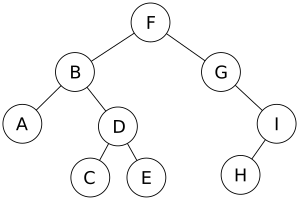
For the following binary tree exercises, refer to the binary tree
below.
Perform a pre-order traversal of this tree, writing down the
letter of a node as you mark it as visited. 5
Perform an in order traversal of this tree, writing down the
letter of a node as you mark it as visited. 6
Perform an post-order traversal of this tree, writing down the
letter of a node as you mark it as visited. 7
Huffman trees
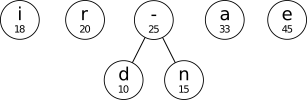
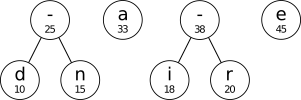
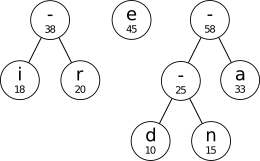
You are given a document in which all characters are drawn from a set
of six possible characters, the frequencies of which have been determined
by analysis of the document. The possible characters and associated
frequencies have been included below.
Use the Huffman tree to decode the following sequence of bits from a
compressed document. 9
00101000100101
Binary search trees
Recall from lecture that a binary search tree is a type of binary tree
in which the nodes in the tree are ordered by a key. A binary tree is
said to be a binary search tree if the following property, the binary search
tree property, holds:
A binary search tree is either an empty tree, or a node with key
k, whose left subtree contains keys less than k, and
whose right subtree contains keys greater than or equal to k.
Insert the following sequence of keys into an empty
binary search tree. 10
We say that a tree is balanced when, for each node, the node’s subtrees
have the same height or have heights that differ by at most one.
Is the resulting tree from the insertions above balanced? 11
Recall the process of deletion from a binary search tree. It is more complex
than deletion from a simple binary tree, since any deletion must preserve
the binary search tree property.
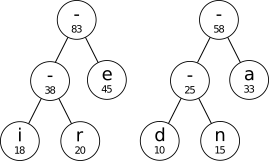
Step 1: initial sorted configurationStep 2: d and n nodes coalesceStep 3: i and r nodes coalesce
Step 4: a node and tree containing d and n coalesce
Step 5: e node and tree containing i and r coalesce
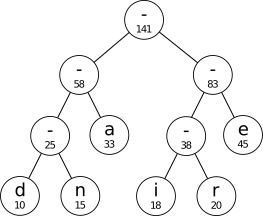
Step 5: subtrees coalesce
↩
Assuming that going left on the tree corresponds to 0 and going right
corresponds to 1, the binary string decodes to the word nadir. ↩
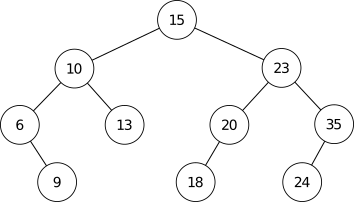
Here’s the tree after all insertions. We stored the data part of the
duplicated 23 key in the existing node. We could have also inserted the
duplicate key as a new node.
If we decided to store the data part of the duplicated 23 key in the
existing node (as we did in the diagram above), the tree is balanced.
However, if we inserted 23 to the left of 35, inserting 24 would cause
the tree to be unbalanced. ↩