If you have questions while working on this assignment, please
come to office hours, post them on Ed Discussion, or email
cscis111-staff@lists.fas.harvard.edu
The Problems
80 points total
Notes:
There are no extra grad-credit problems for this problem set.
There is only one part to this problem set, and all of your
answers should be submitted in a single file (see below).
All of these problems are individual-only. See the
policies on academic conduct
for a reminder of the relevant guidelines.
Creating the necessary folder
Create a subfolder called ps10 within
your s111 folder, and put all of the files for this assignment
in that folder.
Creating the necessary file
The problems will all be completed in a single PDF file.
To create it, you should do the following:
Access the template that we have created by clicking on
this link
and signing into your Google account as needed.
When asked, click on the Make a copy button, which will save a
copy of the template file to your Google Drive.
Select File->Rename, and change the name of the file to
ps10.
Add your work to this file.
Once you have completed all of the problems, choose
File->Download->PDF document, and save the PDF file on your
machine. The resulting PDF file (ps10.pdf) is the one that
you will submit. See the submission guidelines at the end of the
problem set.
Problem 1: Heaps and heapsort
10 points total
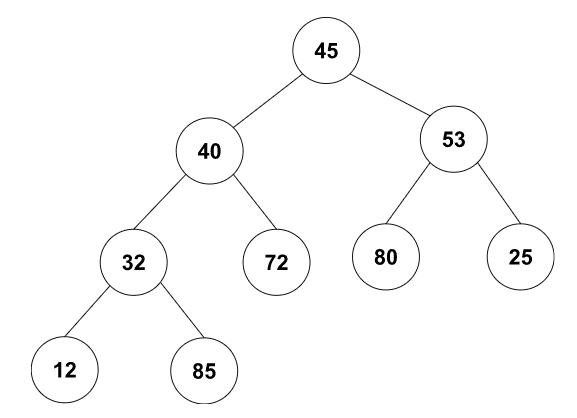
Consider the following complete tree of integers:
(4 points) Turn this tree into a max-at-top heap using the
procedure outlined in lecture, and show the heap that is
produced. In your copy of the ps10 file (see above), edit
the diagram that we have provided by clicking on it and then
clicking the Edit link that appears below the diagram. Make
the necessary changes to the tree to show the final heap, and
then click the Save & Close button.
(2 points) What is the array representation of the max-at-top
heap that you obtain in part 1?
(4 points) Heapsort begins by turning the array to be sorted
into a heap. Assume that your answer to part 2 is the result
of this process of turning the original array into a heap.
What will the heap and the array look like after one
element has been put into its final position by heapsort
– i.e., at the end of the first iteration of the loop in
heapSort()?
What will the heap and the array look like after two
elements have been put into their final positions?
Problem 2: Hash tables
20 points total
The following sequence of keys is to be inserted into an
initially empty hash table of size 8:
cat, goat, dog, bird, bison, ant, flea, bat, duck
The hash function assigns to each key the number of characters in
the key. For example, h("cat") is 3, because "cat" has 3
characters.
Assume that linear probing is used to insert the keys. Add
the above sequence of keys to the table that we have provided
for 2-1 in ps10, stopping at the point at which overflow
occurs.
Now assume that quadratic probing is used. Add the above
sequence of keys to the table that we have provided for 2-2
in ps10, stopping at the point at which overflow occurs.
Finally, assume that double hashing is used, with the value
of the second hash function based on the first character in
the key: a = 1, b = 2, c = 3, d = 4, e = 5, f = 6, g = 7,
etc.
Add the above sequence of keys to the table that we have
provided for 2-3 in ps10, stopping at the point at which
overflow occurs.
Now consider the fourth table provided for Problem 2 in the
ps10 template (the one under section 2-5). Assume that this
hash table is using double hashing with the hash functions
described above. The table includes a number of existing keys,
and positions 2 and 6 are shaded to indicate that they are
removed positions – i.e., ones that used to hold an item that
has since been removed.
If we now insert an item whose key is "eel", what is the
probe sequence – i.e., the sequence of positions examined
during probing – for that insertion?
Show what the table will look like after "eel" is inserted.
Problem 3: List-based priority queue
10 points total
(6 points) A priority queue could be implemented using a list
instead of a heap. Describe how you could use a list to
implement a priority queue in which the remove operation
would have a time complexity of O(1). You may assume either
a list implemented using an array or a list implemented using
a linked list, but make sure to indicate which implemention
you are using.
(4 points) What would be the efficiency of the insert
operation in this list-based implementation? Explain your
answer briefly.
Problem 4: Testing for a path from one vertex to another
10 points total; 5 points each part
A graph may or may not include a path from one vertex to another
vertex. To determine if a path exists, we can add the following
two methods to the Graph class from lecture:
publicbooleanexistsPath(StringstartID,StringendID){// Get the Vertex objects for the two vertices.Vertexstart=this.getVertex(startID);Vertexend=this.getVertex(endID);if(start==null||end==null){returnfalse;// at least one vertex ID was not found}else{this.reinitVertices();// reset "bookkeeping" fieldsreturnexistsPathVertices(start,end);}}privatestaticbooleanexistsPathVertices(Vertexstart,Vertexend){/* Implement this method. */}
The first method (existsPath()) is a fully implemented
non-static method that takes as parameters the string IDs of two
vertices. It begins by using the existing getVertex() method to
obtain references to the Vertex objects for the specified
vertices. If either of the vertex IDs are not found in the
Graph (as indicated by a return value of null from
getVertex()), the method returns false. If both of the
vertices are found, existsPath():
calls the existing reinitVertices() method to reset the
“bookkeeping” fields in all of the Vertex objects in the
Graph
calls the second, not-yet-implemented method shown above
(existsPathVertices()) to determine if there is a path
between the two Vertex objects
returns whatever boolean value it gets back from the second
method.
Note that existsPathVertices() is a private, static method, and
existsPath is a public, non-static method that serves as a
“wrapper” for existsPathVertices(). We have seen pairs of
methods with similar roles in both our LinkedTree and Graph
classes, among other places.
Implement the second method so that it uses recursion to
determine if there is a path in the graph from vertex start
to vertex end. The method should return true if there is
such a path and false otherwise. If start and end
represent the same vertex, the method should return
true. Your code must not use any of the existing
methods of the Graph class.
You are welcome to implement your method in the context of
the Graph class in order to test it, but ultimately you
should include your existsPathVertices() method in section
4-1 of ps10.
To facilitate your testing, we are providing the following
files:
Graph.java - a version of the
Graph class from lecture that includes the starter code
shown above along with a main method that you can use
to test your solution.
To use this class, you will also need the following
classes from the example code provided on our Lectures
page:
highway2.txt - a graph-info
file that is based on the highway graph from
lecture. However, in this version of the graph, the edges
involving Portland are directed edges that go from
Portland to Concord and Portland to Portsmouth
respectively. As a result, there are no paths to
Portland from any other vertex.
To test your code:
Put the above files in the same folder, and replace the
starter code for the existsPathVertices() method with
your implementation of the method. Compile the class, and
fix any syntax errors that are present in your code.
When you run the Graph class, enter highway2.txt when
it asks you for the name of the graph-info file, and
enter the names of the cities that you want to use as the
starting point and ending point.
If you choose a city other than Portland as your starting
point and Portland as your ending point, the program
should tell you that there is not a path between the
two cities. If you choose any other combination of
cities, the program should tell you that there is a
path between the two cities.
For a graph with V vertices and E edges, what would be
the best-case time efficiency of your method from part 1?
What would be the worst-case time efficiency? Use big-O
notation, and explain your answers briefly.
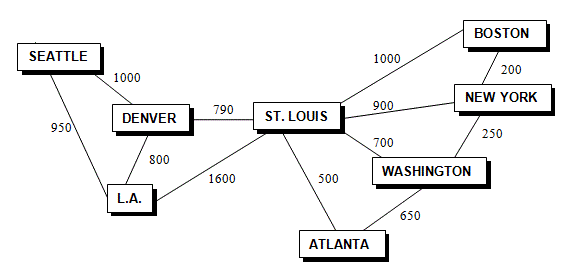
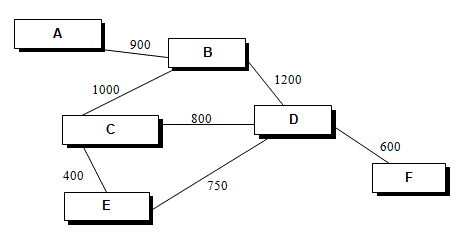
Problems 5-7 refer to the following graph:
Problem 5: Graph traversals
10 points
Suppose that you have purchased a pass that allows you to fly
anywhere you wish along the routes that are shown in the diagram
above.
(3 points) List the order in which you will visit the cities
if you start from Atlanta and do a depth-first traversal. You
should assume that the edges of each vertex are stored in
order of increasing distance, as we did in the lecture
examples.
(2 points) What is the path from Atlanta to Boston in the
depth-first spanning tree? Give the path in the form
A -> B -> C -> etc.
where A, B, and C are vertices.
(3 points) List the order in which you will visit the cities
if you start from Atlanta and do a breadth-first
traversal. You should assume that the edges of each vertex
are stored in order of increasing distance, as we did in the
lecture examples.
(2 points) What is the path from Atlanta to Boston in the
breadth-first spanning tree? Give the path in the form
A -> B -> C -> etc.
where A, B, and C are vertices.
Problem 6: Minimal spanning tree
10 points
(8 points) A cheaper version of the same pass requires that
you confine yourself to flights that are part of a minimal
spanning tree for the graph. List the order in which
flights/edges will be added to this tree if you build it using
Prim’s algorithm, starting from Atlanta. Use the form (city1,
city2) when specifying an edge.
(2 points) What is the path from Seattle to Denver in the
minimal spanning tree? Give the path in the form
A -> B -> C -> etc.
where A, B, and C are vertices.
Problem 7: Dijkstra’s shortest-path algorithm
10 points total
Suppose you set out to use Dijkstra’s algorithm to determine the
shortest distance from Atlanta to every other city in the graph.
(7 points) Fill in the table provided in section 7-1 of
ps10 to show how the distance estimates are refined over
the course of the algorithm. Once a city is finalized, you
should no longer include its distance in subsequent columns.
(3 points) What path(s) does the algorithm discover from
Atlanta to Boston? Include both the final shortest path and
any temporary estimates for the shortest path that are later
replaced. Give the paths in the form
A -> B -> C -> etc.
where A, B, and C are vertices.
Problem 8: Directed graphs and topological sort
10 points total; 5 points each part
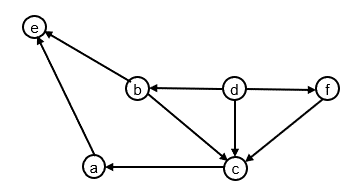
Is the graph below a directed acyclic graph (a DAG)?
If it isn’t a DAG, specify all cycles that are present in
the graph. If it is a DAG, use topological sort to find one
of the possible topological orderings of the vertices in the
graph.
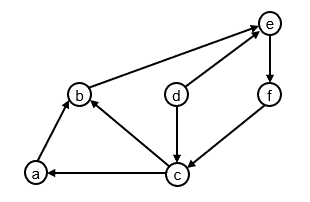
Repeat the process outlined above on the graph below.
Problem 9: Alternative MST algorithm
10 points
Prim’s algorithm is just one possible algorithm for finding a
minimum spanning tree. Another such algorithm was developed by
Kruskal:
kruskal_MST(Graph g) {
    put each of g’s vertices in its own set

    while (there is more than one set) {
        let e = the minimum-cost edge that hasn’t been considered

        if (e connects vertices that are in different sets) {
            add e to the MST
            merge the sets containing the vertices connected by e
        }
    }
}
Note that this algorithm considers the edges in order of
increasing cost. In addition, at an intermediate stage of the
algorithm, there may be multiple trees that are not connected to
each other, although they will ultimately be joined together to
form a single MST.
For example, if we applied Kruskal’s algorithm to the graph
above, we would start out with the following sets:
{A}, {B}, {C}, {D}, {E}, {F}
We would consider the edge (C, E) first, because it has the
lowest cost (400). Because it connects vertices in different
sets, we would add this edge to the tree and merge the sets
involved to get:
{A}, {B}, {C, E}, {D}, {F}
We would next consider the edge (D, F), because it has the
smallest remaining cost. Because it connects vertices in
different sets, we would add this edge to the tree and merge the
sets involved to get:
{A}, {B}, {C, E}, {D, F}
We would next consider the edge (D, E), because it has the
smallest remaining cost. Because it connects vertices in
different sets, we would add this edge to the tree and merge the
sets involved to get:
{A}, {B}, {C, D, E, F}
We would next consider the edge (C, D), because it has the
smallest remaining cost. Because it connects vertices that are
alreadyin the same set, we would not add this edge to the
tree.
We would next consider the edge (A, B), because it has the
smallest remaining cost. Because it connects vertices in
different sets, we would add this edge to the tree and merge the
sets involved to get:
{A, B}, {C, D, E, F}
We would next consider the edge (B, C), because it has the
smallest remaining cost. Because it connects vertices in
different sets, we would add this edge to the tree and merge the
sets involved to get:
{A, B, C, D, E, F}
Finally, we would consider the edge (B, D). Because it connects
vertices in the same set, we would not add this edge to the
tree.
Apply Kruskal’s algorithm to the airline graph from earlier in
the problem set, which is reproduced below. List the edges of the
MST in the order in which the algorithm would add them, using the
format (city1, city2) for an edge.
Submitting Your Work
Submit your ps10.pdf file by taking the following steps:
If you still need to create a PDF file, open your file
on Google Drive, choose File->Download->PDF document, and
save the PDF file on your machine.
Click on the name of the assignment in the list of assignments on
Gradescope. You should see a pop-up window labeled Submit
Assignment. (If you don’t see it, click the Submit or
Resubmit button at the bottom of the page.)
Choose the Submit PDF option, and then click the Select
PDF button and find the PDF file that you created. Then
click the Upload PDF button.
You should see a question outline along with thumbnails of the
pages from your uploaded PDF. For each question in the outline:
Click the title of the question.
Click the page(s) on which your work for that question
can be found.
As you do so, click on the magnifying glass icon for each page
and doublecheck that the pages that you see contain the work
that you want us to grade.
Once you have assigned pages to all of the problems in the
question outline, click the Submit button in the lower-right corner
of the window. You should see a box saying that your submission
was successful.
Important
It is your responsibility to ensure that the correct version
of every file is on Gradescope before the final deadline. We
will not accept any file after the submission window for a
given assignment has closed, so please check your submissions
carefully using the steps outlined above.
If you are unable to access Gradescope and there is enough
time to do so, wait an hour or two and then try again. If you
are unable to submit and it is close to the deadline, email
your homework before the deadline to
cscis111-staff@lists.fas.harvard.edu